How Casino Imagery Reached Gò Vấp Without a Local Casino History
Casino imagery in Gò Vấp travels through film, advertising, and conversation. Learn how to describe its circulation without turning a screen scene into local history.
The common mistake with casino imagery in Gò Vấp is to treat a familiar screen scene as evidence of a neighborhood institution. That costs local history its accuracy: a film set, an advertisement, and a record of an actual venue answer different questions, even when they share green felt and polished counters.
Casino imagery in Gò Vấp traveled through familiar media
A resident may recognize a casino scene from a film, television program, advertisement, or online clip without having visited a casino. The image can travel through dubbed movies, social media, shop displays, and conversation. Its circulation tells us that a visual convention reached viewers; it does not establish that a comparable venue operated nearby.
Casino scenes often rely on a compact set of cues: cards or chips, a gaming table, formal clothing, and faces fixed on the action. Together, those objects make a setting legible at a glance. Their cultural work is not to document a particular address, but to let an audience recognize a scene before the next cut.
Screen scenes and advertisements use different visual shortcuts
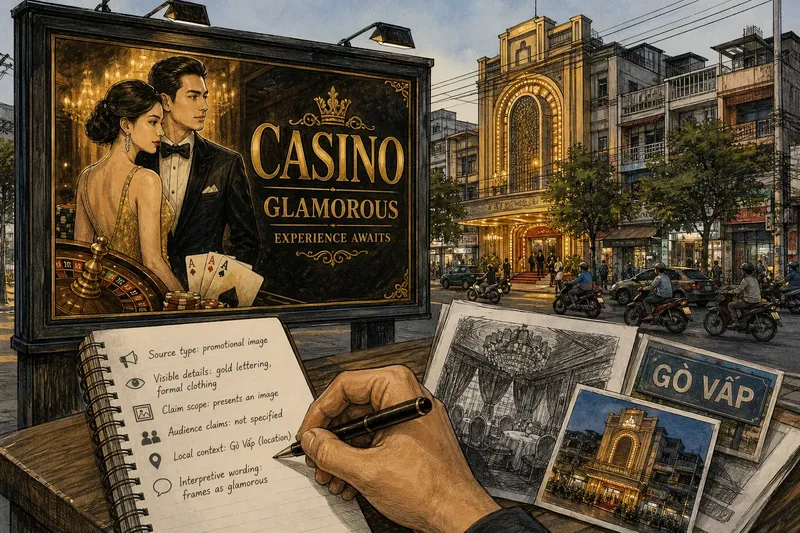
Film can build a mood from movement and reaction. A close shot of a hand placing a chip or a player’s expression can carry the scene, while the entrance, staff routines, and street outside remain unseen. An advertisement may compress the same idea into a roulette wheel, a stack of chips, or theatrical lighting. These are signs of a chosen image, not a map of where the image was encountered.
The familiar objects can also carry different meanings for different viewers. One person may read a casino tableau as glamour, another as risk, and someone else may simply recognize a film genre. Those interpretations belong to particular viewers or contexts; they should not be assigned to Gò Vấp residents as a group without evidence for that claim.
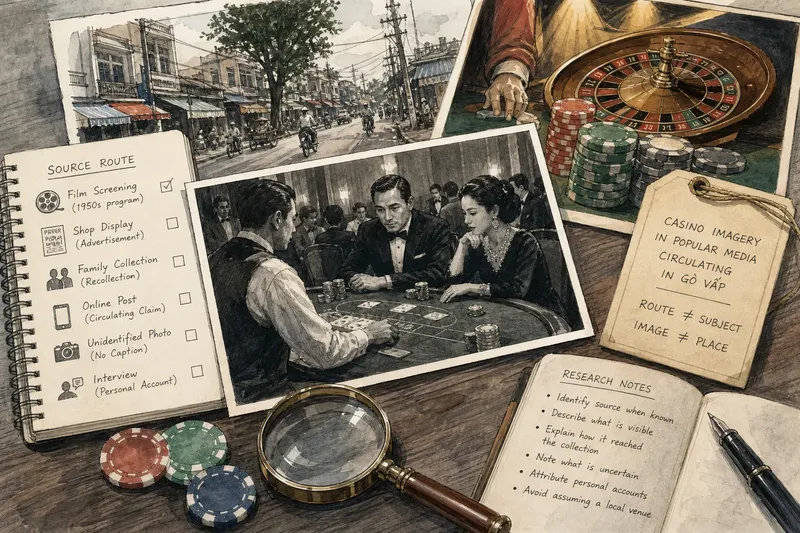
Say a neighborhood cultural group has a film still showing a dealer, a card table, and two formally dressed players. It identifies the film, notes those visible details, and displays the still as an example of casino imagery circulating in popular media. Because the frame shows no street or address, the group does not label it as a picture of a Gò Vấp venue.
Trace how an image entered a local display
For an exhibit, article, or neighborhood archive, the useful question is often not whether an image depicts a real local venue. It is how that particular image reached the collection and what role it plays there. A program, poster, clipping, or recorded recollection can explain whether it came from a film screening, a shop display, a family collection, or an online post.
Keep the object and its route distinct. A film still may show a fictional casino, while a program or collection note documents that residents encountered the film. The second item can support a claim about local circulation without turning the first into a photograph of local life.
- If a film still has a title or production credit, check the accompanying program or catalog; if the source is confirmed, identify the still as film imagery, and if not, mark the source as uncertain.
- If a poster or advertisement names a business, compare that name with a dated directory or contemporaneous report; if the record supports a local connection, state the narrow connection, and if not, describe only the advertisement’s visible wording.
- If a family collection includes a dated note about where an image was seen, record who supplied the note and what it says; if the note does not identify a place, leave the location open rather than filling it in.
- If an online post repeats a venue story, trace the claim to its earliest available dated source; if no supporting source appears, describe it as a circulating claim, and if a source does appear, state only what that source establishes.
- If a photograph shows cards, chips, or a gaming table but lacks a caption, inspect the original file, sleeve, or catalog entry; if none identifies its origin, describe the visible objects and keep the setting unidentified.
- If an interviewee recalls seeing casino imagery at a screening or shop, ask what they remember seeing and where; if the account names a specific event, attribute it to that person, and if it remains general, present it as a recollection rather than a dated record.
How can you describe casino imagery without overstating its history?
Does a familiar casino scene show that a local venue existed?
No. A scene may reach Gò Vấp through film, advertising, or online circulation without documenting an address there. A claim about a local venue needs a source tied to that place and the period being discussed.
What belongs in a caption for a casino-themed image?
Identify the image’s source when known, then describe what is visible and where the image came from. If its origin or location is unclear, say so rather than supplying a confident caption the material cannot support.
Can a resident’s recollection explain how an image circulated?
Yes, when it is attributed as a personal account and kept distinct from a contemporaneous record. A recollection can describe a screening, display, or conversation; it need not carry the weight of a complete neighborhood history.
Why do casino scenes look alike across films and advertisements?
Cards, chips, tables, and formal dress work as quick visual signals across different media. Like a shop sign, they tell viewers what kind of scene they are looking at, not which specific place lies behind it.
Write captions that identify the image’s role
A caption can say that an image is a casino-themed film still, name the film if its source is confirmed, and explain that it was collected or displayed in Gò Vấp if that route is documented. Those details distinguish the image’s subject from its local history.
If the source is not confirmed, avoid presenting a polished caption as though it were complete. A plain note such as “Unidentified casino-themed image; source and date not established” is less elegant, but it does not smuggle a location into the record. Casino imagery in Gò Vấp is worth tracing through its actual routes of circulation; the label should tell readers which route is known and which remains open.