Choosing a Casino Motif: Cards, Dice, or Chips
Choosing a casino motif becomes easier when you match cards, dice, or chips to a scene’s tension and give each object a clear visual role.
The common mistake in choosing a casino motif is filling the frame with familiar props before deciding what the scene is about. That can cost the image its point of view: cards, dice, and chips may identify a gaming setting, but they do not tell the same story. Choosing a casino motif well starts with the scene’s central tension.
For a fictional casino scene in Gò Vấp, a designer might draw on a neighborhood café’s close tables or invent a polished gaming floor. Either way, the props can suggest a private contest, a public spectacle, or an orderly system of play. The useful distinction is not which object looks most like a casino, but which one gives the image its particular character.
Match the motif to the scene’s pressure
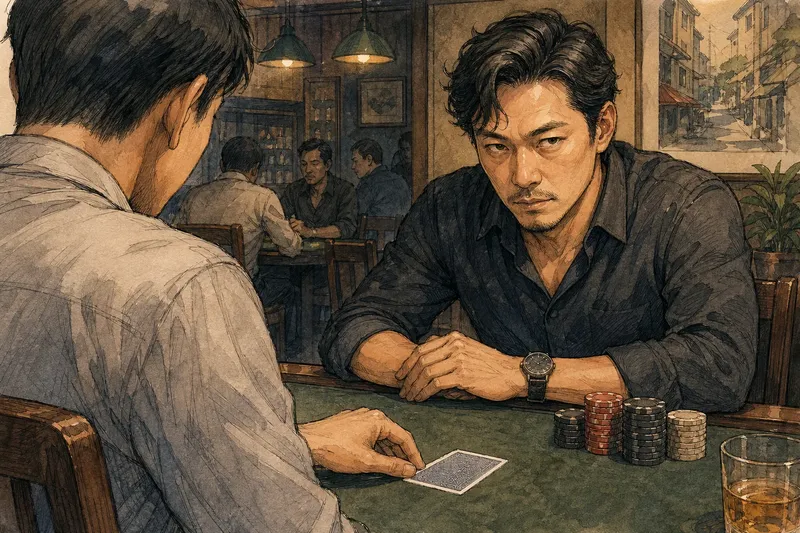
Say a designer is making a poster for a fictional short film set in a discreet Gò Vấp card room. The story follows a visitor trying to judge whether another player is trustworthy. A first draft puts a bright stack of chips in front because it reads quickly. That choice directs attention to status and stakes, not the uncertain relationship at the center of the story.
The designer changes the leading object to a face-down card, with another person’s hand resting nearby. The expected result is an image focused on an exchange that has not yet resolved. Chips can remain near the table’s edge to establish the setting, but they no longer carry the poster’s main idea.
This invented situation points to a useful distinction: the setting’s props identify the place, while its leading motif gives the scene a visual argument. A casino image does not need every familiar object to make its subject clear.
Cards turn a social contest into a focal point
Cards suit scenes built around decisions, concealed information, or the fragile effort to read another person. Their small scale lets the image place tension in a hand, a glance, or the space between two players. A fan of cards creates a repeating pattern; one isolated card makes a more pointed focal shape.
The specific card detail should serve the image’s design. A clearly visible hand can evoke a recognizable game, while a blank-backed or turned card leaves the scene open to interpretation. If the design names or depicts a particular game, its cards should fit that game. Otherwise, a symbolic card can avoid details that promise more specificity than the scene needs.
Cards are not automatically the right choice for every thoughtful or tense scene. If the drama comes from a public result rather than a private decision, their quiet, close-up quality may make the image feel too intimate.
Dice make an outcome feel exposed
Dice bring chance into the open. In motion, they suggest an outcome about to arrive; resting on a table, they make the result feel settled. That difference lets their position carry the scene’s timing without adding explanatory text.
Dice fit a story about risk, impulsiveness, or the moment a character gives up control to an unpredictable result. They also tend to make a composition feel more kinetic than a concealed card does. For the fictional Gò Vấp poster, dice would shift the emphasis from judging another player to awaiting luck, which is a different story.
Chips show the structure around play
Chips can stand for organized stakes, rank, accumulation, or the rules that shape a table. Neat stacks suggest control and arrangement; scattered chips can make the scene feel unsettled. Because chips are familiar casino shorthand, they establish the setting quickly, but may also make money or status seem like the main subject.
Think of the props as everyday objects on a desk: a sealed envelope withholds something, a tossed coin produces a chance result, and a row of counters keeps track of a system. The analogy is modest, like a paper label on a drawer, but it helps separate the jobs each object can do in a composition.
Use this motif decision list to choose the lead object
- Check whether the scene centers on information one person withholds; if it does, lead with a concealed card, but if it centers on a public outcome, choose dice instead.
- Check whether the central beat is a result about to happen; if it is, show dice in motion, but if the result has already landed, show them settled or use another object that marks consequence.
- Check whether rank or accumulated stakes drive the scene; if they do, make chips prominent, but if the drama is interpersonal, move chips to the edge and let a card or character lead.
- Check whether the image needs to identify a casino quickly; if it does, keep a restrained chip stack or card table in view, but if the location is already clear, remove the extra prop and reserve space for the story’s focal object.
- Check whether a visible card is meant to name a specific game; if it is, use details consistent with that game, but if exact game identity is unnecessary, turn or obscure the card face.
- Check whether several props compete for the same visual attention; if they do, choose one lead motif and demote the others, but if each supports a different part of the scene, keep the secondary objects small and distinct.
Which casino motif fits the scene?
When should a scene use cards?
Use cards when a character’s choice or withheld information matters more than the result of chance. Their close scale makes them useful for a social contest built around attention and judgment.
When do dice communicate the right idea?
Use dice when chance itself drives the scene. Their motion can suggest anticipation, while a settled pair can make the result feel exposed.
What do chips add that cards and dice do not?
Chips show the organization of stakes and play, making them useful for scenes about rank or accumulation. They can also draw the image toward money, so keep them secondary when another tension matters more.
Can a scene use more than one motif?
Yes, if one object leads and the others support the setting or action. When every prop competes for the foreground, the image can become a crowded inventory rather than a scene with a point of view.
Keep secondary props in their proper role
In the invented poster, the designer starts with chips as the main image, replaces them with a face-down card, and retains a small chip stack at the table’s edge. The observable result is a composition in which the card draws the eye while the chips still locate the action. The tradeoff is deliberate: the image gives up an immediate display of status to emphasize uncertainty between the characters.
For a final check, describe the scene without naming its props. If the sentence is about withheld information, cards may be doing useful work; if it is about an unpredictable result, dice may fit better; if it is about rank or accumulated stakes, chips may deserve the lead. That is a practical way to choose a casino motif without mistaking a familiar object for the whole story.