A Casino Scene Without the Usual Neon
Read a casino scene without neon by tracking its working routines, sound, and social roles, and explain how the film makes the room feel ordinary or tense.
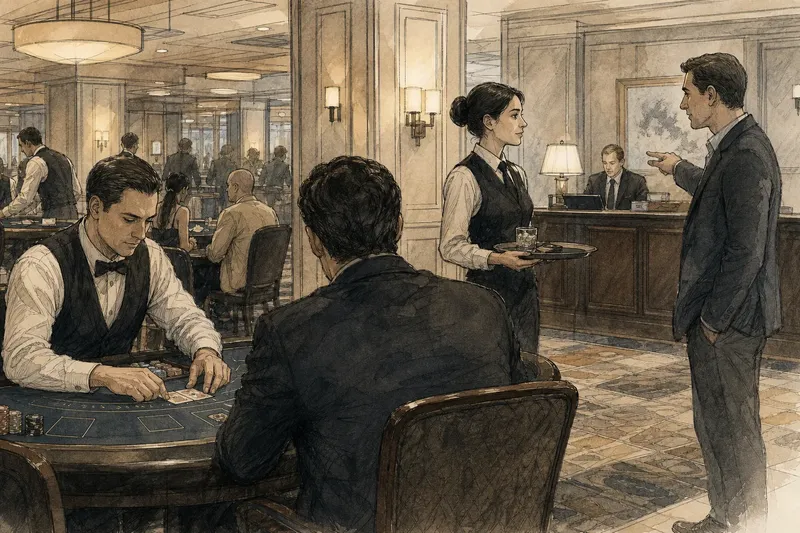
The most common mistake in reading a casino scene without neon is to treat it as an anonymous room and wait for dialogue to identify it. That costs the scene its social texture: the division between guests and workers, the routines that keep play moving, and the unease of a room designed to make activity feel continuous. A casino can announce itself through labor and habit, not just glowing signs.
This approach is useful for viewers, film students, and writers considering how a casino setting works on screen when spectacle is deliberately muted. The question is less what each object symbolizes than what kind of institution the scene depicts. Is it a place of hospitality, controlled access, routine work, or a social encounter that happens to involve a game?
Start with the room’s working routines
Watch what people do repeatedly. A dealer gathers cards, a server carries drinks, a guest waits for a turn, and someone at a desk attends to an ordinary request. These actions can make the room feel organized even when the characters are unsettled. They also reveal the casino as a workplace with guests, procedures, and roles, rather than a stage built solely for dramatic players.
Listen for the rhythm of those tasks. A scene may keep the sound of cards, low conversation, footsteps, or a distant announcement in the foreground. If the soundtrack leaves these noises intact, the room can feel occupied and functional. If it suppresses them, an otherwise ordinary action may seem isolated or ominous.
Imagine a scene set in a fictional, modest casino where a guest asks a server for directions while a dealer continues arranging cards nearby. The starting point is a routine exchange, with no argument or conspicuous display. The server answers and resumes carrying a tray; if the camera stays with that ordinary traffic, the expected effect is a setting that feels like a service environment, not a private contest. If the edit instead cuts to the guest’s watchful face and drops the room noise, the same exchange can acquire a suspicious tone.
Distinguish hospitality from control
Casinos on screen often combine welcome with rules. A greeting, a drink, or attentive service may make the setting seem hospitable, while staff positions and repeated procedures remind the audience that the space is managed. The tension comes from the coexistence of those functions, not from any single object serving as a secret symbol.
Notice how the scene handles requests and interruptions. Does a worker pause to help, direct the guest elsewhere, or quietly restore the room’s routine? Does a character treat staff as people with tasks or as part of the furniture? Those choices shape the social world of the scene and can reveal more than a decorative display of wealth.
A fictional scene in which a guest asks to move a chair gives a useful contrast. If a staff member responds promptly and the conversation continues, the room may read as accommodating; if the request is ignored while a supervisor watches, the scene may suggest controlled access or social distance. Neither interpretation is automatic: costume, performance, sound, and what happens next should support it.
Read casino culture through roles, not clichés
Screen casinos can inherit familiar ideas about luck, risk, glamour, and excess. A quieter scene may resist those associations by giving time to routine service, waiting, or awkward conversation. It may also reproduce them indirectly, through a character who treats the room as a place where money and status settle every question.
Keep the setting’s public image separate from the scene’s specific choices. A film can show a casino as polished and welcoming while making one character feel out of place. Another can make an unadorned room feel prestigious through formal speech and attentive service. The useful question is what the scene asks the audience to notice about its people and customs, rather than whether the room matches a familiar image.
For a close reading, note who is treated as an insider. A character who knows how to wait, ask, or move through the room may seem at ease; someone who hesitates may appear unfamiliar, regardless of the room’s decor. These are social cues in the performance, not proof that every casino operates the same way.
What should you listen for in a restrained casino scene?
How can routine make a casino feel tense?
Routine can become tense when a character’s attention conflicts with the room’s steady pace. A calm dealer or passing server may continue working while a guest waits for news, making the guest’s stillness more conspicuous.
Does quiet sound mean the room is empty?
Not necessarily. A subdued mix may retain small sounds such as footsteps, cards, or conversation while lowering the general din. Consider whether the scene presents quiet as ordinary concentration or as an unusual absence.
How do workers shape the casino’s screen image?
Workers show the labor behind the room’s apparent ease. Their gestures, routes, and responses can make the setting feel organized, attentive, impersonal, or strained, depending on how the scene presents them.
Can an unadorned room still feel glamorous?
Yes. Formal behavior, careful service, and a character’s expectations can create an impression of status without bright decoration. The scene’s tone comes from the combination of performance and setting, not from ornament alone.
Use a short observation list before interpreting
When a scene seems hard to read, separate what is plainly present from what you infer. Use the following checks to decide which details deserve attention; each result points to a different reading rather than a fixed code.
- Check who performs repeated tasks. If staff members keep the room running while guests wait, read the setting as a workplace as well as a leisure space; if the scene omits workers, consider whether it presents the casino as an exclusive social world instead.
- Check whether service interrupts or continues through the main action. If a server pauses to help a character, the scene may stress hospitality; if service carries on without acknowledgment, consider whether it emphasizes routine or social distance.
- Check which everyday sounds remain audible. If footsteps, cards, or conversation stay present, read the room as occupied and functional; if those sounds disappear around one character, consider whether the mix isolates that person.
- Check how a request is handled. If staff respond and the scene moves on, consider a welcoming atmosphere; if the request is redirected or ignored, consider a more controlled or impersonal one.
- Check whether characters know the room’s customs. If someone waits, asks, and moves with ease, consider that they are being presented as familiar with the setting; if they hesitate, consider whether unfamiliarity is part of the scene’s tension.
- Check whether the action returns to its routine after an interruption. If it does, the scene may stress institutional continuity; if the interruption changes how people behave, consider whether the event has unsettled the room.
Keep observation separate from interpretation
Begin with a concrete account of the scene: “The server answers the guest, then carries the tray past the table while the dealer continues arranging cards.” That describes visible action. A possible interpretation is that the film gives equal weight to service and play. Keeping the two statements distinct makes it easier to revise the reading when another detail complicates it.
Sound, dialogue, costume, and editing can all alter the impression. A low mechanical hum might keep attention on the room’s routine; a sudden cut to a silent close view could make the same surroundings seem threatening. Avoid treating dim light as automatic danger or polished surfaces as automatic wealth. The scene may draw on those associations, but it can also redirect them.
When the evidence remains ambiguous, leave room for more than one reading. A restrained scene may withhold a clear judgment about whether its characters feel welcomed, watched, or simply busy. Precision is not the same as certainty.
Build a reading around the scene’s social world
Choose one repeated task, one interaction between a guest and a worker, and one sound or pause. Describe what each contributes, then connect them to a specific effect: perhaps the room feels attentive but impersonal, or ordinary until one character’s behavior disrupts its routine. This gives the interpretation a clear basis without turning every detail into a symbol.
For instance, a scene might show a dealer continuing a practiced routine, a server briefly helping a guest, and room noise remaining steady as the guest looks toward the entrance. Together, those choices could make the casino feel socially functional while leaving one character uneasy. The point is not that a casino always means one thing; it is that the film’s treatment of work, service, and attention shapes this particular room.
For a casino scene without neon, the most revealing detail may be a routine that continues while someone else hesitates. That contrast can make a room feel calm, watchful, or indifferent without announcing its mood. When you search for the casino scene without neon, listen for what the room keeps doing around its characters.